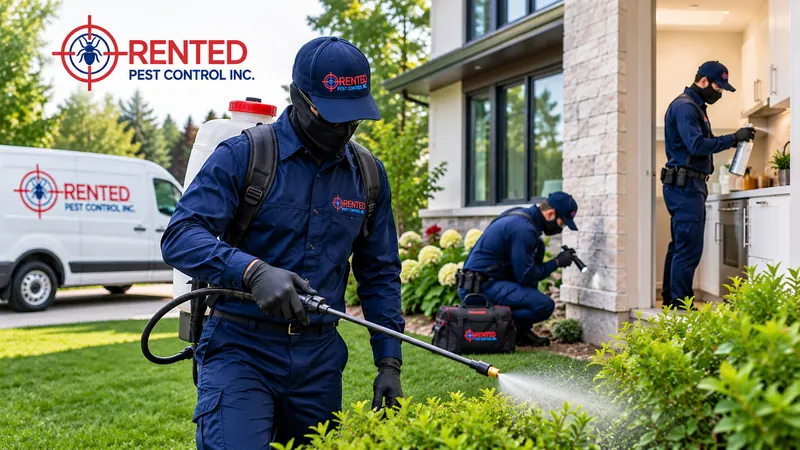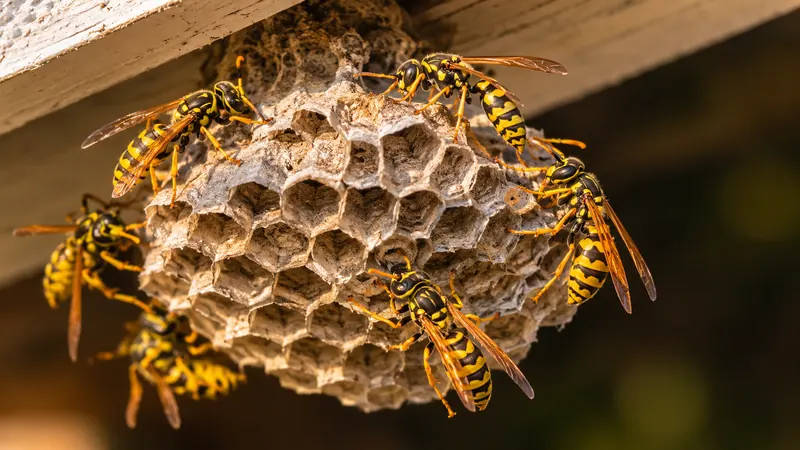
Yellow jackets, paper wasps and hornets build nests in eaves, sheds and wall voids, and become more aggressive as summer turns to fall. We treat and remove the nest safely so stings aren't a risk.
Get Your Free Quote
Quick reply, no obligation.
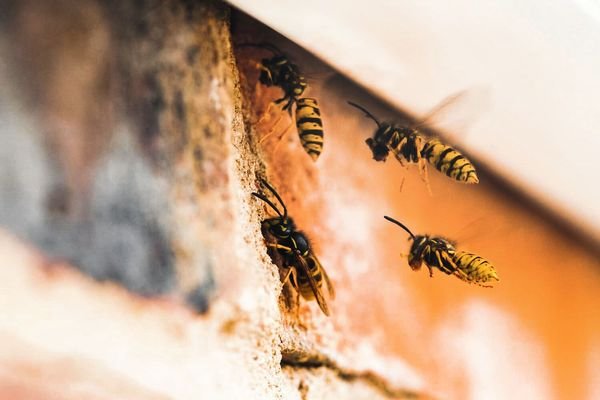
For homeowners, a wasp nest is usually first noticed by steady insect traffic in and out of a gap in the eaves, a shed, or a hole in the siding. Our technicians identify the species and nest location, then treat the nest directly with a targeted dust or insecticide before removing it.
Commercial properties — patios, loading docks and outdoor dining areas — need nests removed quickly to avoid sting risk to staff and customers. We treat active nests on-site and check nearby eaves, soffits and sheds for additional nests before closing out the job.
Our wasp nest removal technicians are trained, licensed, and held to the same standards across every job we do.
A safe process that treats the nest directly instead of just the wasps you see flying.
We locate and treat the nest itself, whether it's aerial, in the ground, or hidden inside a wall void.
Our technicians use protective gear suited to the species and nest size, so removal stays safe for everyone nearby.
Every treatment is carried out by technicians licensed to Ontario Ministry of the Environment standards.
Nests aren't always easy to spot until wasps are already defending them aggressively. Call us if you notice:
Nests built in wall voids or underground are often the hardest to spot and the most dangerous to disturb without the right equipment.
We identify the wasp or hornet species and locate the nest, whether it's aerial, ground-level, or hidden inside a wall void.
We use protective equipment suited to the nest size and species before beginning treatment.
We apply a targeted dust or insecticide directly into the nest entrance to eliminate the colony at the source.
Once activity has stopped, we remove the nest itself to prevent reuse or secondary pests.
We check nearby eaves, soffits and sheds for additional nests before closing out the job.
Treating the nest directly, rather than just the wasps flying around it, is what stops the colony from rebuilding in the same spot.
Wasp colonies grow steadily through spring and summer as workers forage to feed developing larvae. By late summer, colonies reach their largest size and workers become noticeably more defensive, especially once the queen stops laying eggs and the colony's food-sharing routine breaks down.
This is also when nests near entryways, patios and outdoor dining areas pose the greatest sting risk, since defensive behaviour increases right as more people are outdoors enjoying the warm weather.
Never attempt to remove or spray a nest near an entryway, vent or window yourself. Disturbing a nest without the right equipment is one of the most common ways people are stung, and a damaged nest can scatter wasps into living spaces.
Got a wasp nest? Call Orented at 647-920-5580 or request your free estimate online.
Yellow jackets build enclosed nests often in the ground or wall voids and are the most aggressive; paper wasps build smaller, open umbrella-shaped nests under eaves; bald-faced hornets build large grey aerial nests and defend them aggressively. Identifying the species affects how we approach removal.
We don't recommend it. Disturbing a nest without proper protective equipment often provokes a defensive swarm, and nests near entryways or vents are especially risky to approach. A professional treats the nest directly with the right equipment the first time.
Yes. Wall-void nests are treated through the entry point wasps are using, and we check for secondary openings before closing out the job.
Colonies reach their largest size by late summer, and once the queen stops laying eggs, workers become noticeably more defensive around the nest.
Once a nest is treated and removed, wasps won't reuse it, though a new colony could build nearby in a future season if entry points aren't sealed.
Fast wasp nest removal for homes and businesses throughout Vaughan and the GTA — most inspections can be scheduled within 24 hours.